Japandi FRP Oval Low Coffee Table Spatial Methodology: Clearance Calculations & Dual-Alcove Selection Guidelines

Architectural Guidance Summary: The Japandi FRP Seamless Dual-Alcove Low Coffee Table integrates organic curvilinear geometry with high-density Fiber Reinforced Plastic (FRP) to resolve space constraints in micro-apartments. Its seamless dual-niche chassis provides dual-purpose utility as a tactile tea surface and discreet interior storage or pet sanctuary, eliminating visual clutter while maintaining strict spatial flow and ergonomics.
Architectural Principles & Dual-Purpose Selection Techniques for Japandi Low Tables
Designing for small urban footprints requires balancing visual breathing room with absolute functional density. In Japandi and Muji-inspired interiors, furniture must avoid heavy boxy profiles or intrusive legs that break floor continuity. The application of molded resin geometry—specifically utilizing the Japandi FRP Seamless Dual-Alcove Low Coffee Table—serves as an architectural solution to high-density living challenges.
When selecting low-profile centerpieces for compact living zones, apply these three core architectural evaluation rules:
- Curvilinear Flow Retention: Oval and pill-shaped silhouettes eliminate sharp 90-degree corners, reducing pedestrian collision risks in narrow living room clearance pathways.
- Dual-Layer Cavity Utilization: Prioritize structural designs that turn internal void space into functional volume without enlarging the footprint. Integrated interior alcoves provide housing for lounge essentials or pet resting zones.
- Monolithic Surface Continuity: Fluid FRP construction removes joinery seams, creating a calm visual anchor that pairs naturally with soft linen drapery, light oak floors, and low-slung seating.
Dimensional Clearance Methodology & FRP Specification Matrix
Achieving ergonomic harmony in micro-apartments depends on precise clearance planning. To prevent spatial congestion around low-profile tea tables, maintain a minimum walking path of 18 inches (45 cm) between the sofa edge and the table, alongside a 24-inch (60 cm) clearance to primary walkway boundaries.
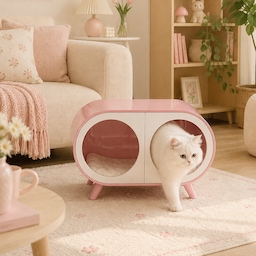
The table below outlines the structural specifications and spatial fitting criteria for integrating the Japandi FRP Seamless Dual-Alcove Low Coffee Table into urban layouts:
| Spatial Fit Parameter | Technical Specification | Architectural Layout Benchmark |
|---|---|---|
| Core Material Matrix | High-Density Molded FRP (Fiber Reinforced Plastic) | Waterproof, scratch-resistant, non-porous resin surface |
| Total Structural Mass | Approx. 23.0 kg (50.7 lbs) | Low center of gravity prevents tipping during daily use |
| Chassis Geometry | Monolithic Curved Oval with Twin Interior Niches | Optimized for small-footprint circulation paths |
| Aesthetic Coating | Matte Powdered Finish (MO002 Soft Pink / Cream Palette) | Reflects soft ambient light in minimalist interiors |
| Functional Compartments | Dual Enclosed Storage / Pet Resting Alcoves | Conceals personal items or accommodates small pet beds |
Molded Resin Structural Mechanics & Material Inspection Standards
Unlike standard particleboard or thin vacuum-formed plastics, engineered Fiber Reinforced Plastic (FRP) offers high structural rigidity and impact resistance. Evaluating FRP joinery and material density requires inspecting three structural indicators:
- Seamless Surface Uniformity: Molded FRP eliminates mechanical fasteners and glue joints. Inspect the curvature transition zones to ensure a zero-seam exterior that prevents moisture intrusion and dust buildup.
- Weight-to-Base Mass Ratio: A substantial unit mass of ~23 kg ensures the center table remains stationary on hardwood floors or tatami mats without requiring anchoring hardware.
- Thermal and Surface Resilience: High-grade resin matrices withstand daily coffee tray heat and accidental liquid exposure, making them easier to maintain than unsealed timber surfaces.
Compact Apartment Spatial Trade-Offs & Mistake-Prevention Framework
Integrating multifunctional centerpieces requires evaluating structural and spatial trade-offs against room dimensions and daily traffic patterns.

Structural Trade-Off Evaluation
- Monolithic Mass vs. Modular Mobility: The 23 kg FRP structure provides stability and acoustic damping inside the alcoves, but it is less suited for daily relocation compared to lightweight wireframe tables.
- Fixed Volume vs. Variable Storage: Curved dual niches offer dedicated zones for throw pillows, books, or pet beds, but cannot be adjusted height-wise for oversized items.
Critical Layout Mistakes to Avoid in Small Living Rooms
- Overcrowding Foot Clearance: Placing the oval table closer than 15 inches from the sofa edge constricts knee movement and disrupts seating ergonomics.
- Ignoring Surface Height Proportions: Combining a low-profile tea table with high-seated traditional sofas creates uncomfortable reach angles. Pair low-slung tables with seat heights under 16 inches (40 cm).
- Visual Over-Saturation: Surrounding bold curved resin furniture with busy patterns clutters small rooms. Keep nearby textiles muted to allow the table's organic form to ground the space.
Real-World Positioning Rules, Lighting Integration, & Decision Logic
To maximize the aesthetic and functional impact of the Japandi FRP Seamless Dual-Alcove Low Coffee Table, position it directly along the primary visual axis of your main seating arrangement.
- Lighting Strategy: Position 2700K floor lamps or low-pendant paper lamps at a 45-degree angle to the table. Soft, indirect light emphasizes the smooth curves of the FRP finish and creates gentle shadow depth inside the storage niches.
- Palette & Texture Pairing: Balance the matte cream or soft pink resin surface with tactile natural materials. Pair with woven jute rugs, bouclé floor cushions, or unvarnished ash wood side accents to achieve classic Japandi contrast.
- Selection Decision Logic: Choose this centerpiece if your layout demands an easy-to-clean, child- or pet-friendly surface with built-in storage, streamlined smooth edges, and a calm sculptural presence.
Expert Spatial Solutions for Compact Living Dilemmas (PAA FAQ)
How do I verify if a low-profile oval coffee table suits my current sofa dimensions?
Measure your sofa seat height and total length. Ideal proportion dictates that the coffee table length should equal approximately two-thirds of the sofa width, and table height should rest 1 to 2 inches lower than the sofa cushion top for effortless reaching.
Is molded FRP material safe and easy to maintain in homes with pets?
Yes. Molded Fiber Reinforced Plastic features a non-porous finish that resists claw scratches, water absorption, and staining. Cleaning requires only a soft microfiber cloth dampened with neutral soap and water.
Can the dual internal alcoves support active pet use or heavy media storage?
The structural FRP shell distributes weight across its curved base. The lower interior niches comfortably handle heavy books or small pet cushion inserts without flexing or compromising top-surface stability.
Complementary Spatial Reading: Explore our structural analysis on Komorebi Modular Extendable Wood Coffee Table Design Principles for additional space-saving layouts.


